Introduction
Once upon a time… is how most stories begin. Others are told with a paintbrush and a canvas. However, women’s stories are often erased, buried, and required to be extracted from between the lines of old dusty history books. Artists provide a more tangible opportunity to share women’s stories. Laurena Finéus represents the experiences of Haitian women in her paintings, featured in the Déchoukaj’ exhibition, illustrating and uplifting their stifled stories, captured from the lens of her diasporic perspective. Three of her paintings shall be examined: It was up to me to make sure my daughter never slept with ghosts, May this country be hers one day, and Imagine our surprise when we found out we had limits. This research asks, how are Haitian women and their life stories represented in art? Haitian “art plastique”, as described by Célius, who was influenced by Dominique Chateau’s L’art comme fait social total, is known by its three factors, colour, lines, and volume (Toussaint 2007, 260), all of which will be considered in the analysis of Finéus’ works. Additionally, Célius notes that Haitian art is a means of showcasing one’s identity (Toussaint 2007, 260) which Finéus continuously highlights within each of her paintings from the Déchoukaj’ exhibition. Laureuna Finéus’s biography and family history will be shared, Souriau’s “transcending” mode of existence (Souriau 1969, 1279) simmering in the background of the analysis, in relation to the representation of the generational experiences of Haitian women transcending in Finéus’ works.
I had the privilege of meeting the artist and gaining another dimension of knowledge from Laurena Finéus’ gracious vulnerability, causing my personal conversation with the artist about her paintings to play a role in shaping the research as that information is sprinkled throughout. How Haitian literature impacted the artist will be discussed, and how its effects are portrayed on the canvas. Concepts such as the gaze, migration, postcolonialism, memory, nostalgia, patriarchy, femicide, double absence, and double presence will be tied to her artworks. After the initial examination of Finéus’ paintings, her self-portrait will be compared and contrasted to Frida Kahlo’s, tackling ideas of masculinization and surrealism. Lastly, through a conclusive reflection, the importance of analyzing Finéus’ work, its significance for the history of art, and its contributions to aestheticization will be answered. The research will leave the reader reflecting on how the next generations of Haitian artists from the diaspora will represent women’s stories.
Biography
Laurena Finéus, grew up as an only child in a matriarchal home in Gatineau, with her mother and grandmother (Personal Communication 2024). Her grandmother first immigrated to Canada in the 1970s (Gené 2021), working as a nanny, to support her family and bring her children from Haiti to join her in North America (Personal Communication 2024). One of her seven children was Finéus’ mother (Personal Communication 2024). Born in Canada, Laurena Finéus identifies as a “Haitian-Canadian interdisciplinary artist” and an educationalist, having conducted a variety of workshops in various art communities of Ottawa (Finéus 2024). She studied at the University of Ottawa, graduating with a Bachelor of Fine Arts, and four years later in 2024, received her MFA from Columbia University, where she is now based in Brooklyn New York (Finéus 2024). Finéus has been awarded the Ineke Harmina Standish Memorial, the Ottawa Arts Council IBPOC emerging artist award, the Helen Frankenthaler fund, the Elizabeth Greenshields Foundation grant, and most recently, the Saunderson Prize (Finéus 2024). Her works belong to private collections but have also been displayed publicly on an internationallevel at Google, the Canada Council Art Bank, and the City of Ottawa’s Art Collection (Finéus 2024). Finéus’ art has been shown in many institutions, to name a few, the Ottawa Art Gallery, Art mûr, and Brooklyn Museum (Finéus 2024) but we will focus on her first solo exhibition (Personal Communication 2024) at the Ottawa School of Art Gallery, called Déchoukaj’ (Katsman 2024).
Déchoukaj
The term Déchoukaj surfaced in 1986 after the fall of Duvalier’s regime, shifting the political systems of Haiti (Jean-Pierre 2021, 135). The word can be traced back to the French term “désouchage” but in Haitian Kréyol it is used to describe an “uprooting of a tree” to the extent that its roots dangle out of the soil (Katsman 2024). Gage Averill explains that the concept of déchoukaj was applied by “popular” groups to demonstrate how deeply Duvalier’s dictatorship had seeped itself into the roots of Haitian culture and society (Jean-Pierre 2021, 136). Déchoukaj is categorized as a revengeful paradigm of protest (Jean-Pierre 2021, 136) since it constitutes destroying anything related to the corruption of the past, including the “henchmen” of the system and all of their belongings, as a form of taking back the power (Katsman 2024).
All that being said, Finéus titled her 2021 exhibition Déchoukaj’, recounting the stories of five Haitian women in her life, including those of her family in her paintings (Katsman 2024). Finéus’ work in this exhibition was an uprooting or “déchoukaj” of the patriarchy within Haitian culture (Katsman 2024). Finéus utilizes the “hybridity” of being a member of the Canadian diaspora in her paintings (Katsman 2024), with the aid of Haitian literature written by women (Personal Communication 2024). She lays bare the stories of these women, allowing the viewer to catch a glimpse of their lives (Katsman 2024), their soft memories, and their harshest hardships.
It was up to me to make sure my daughter never slept with ghosts
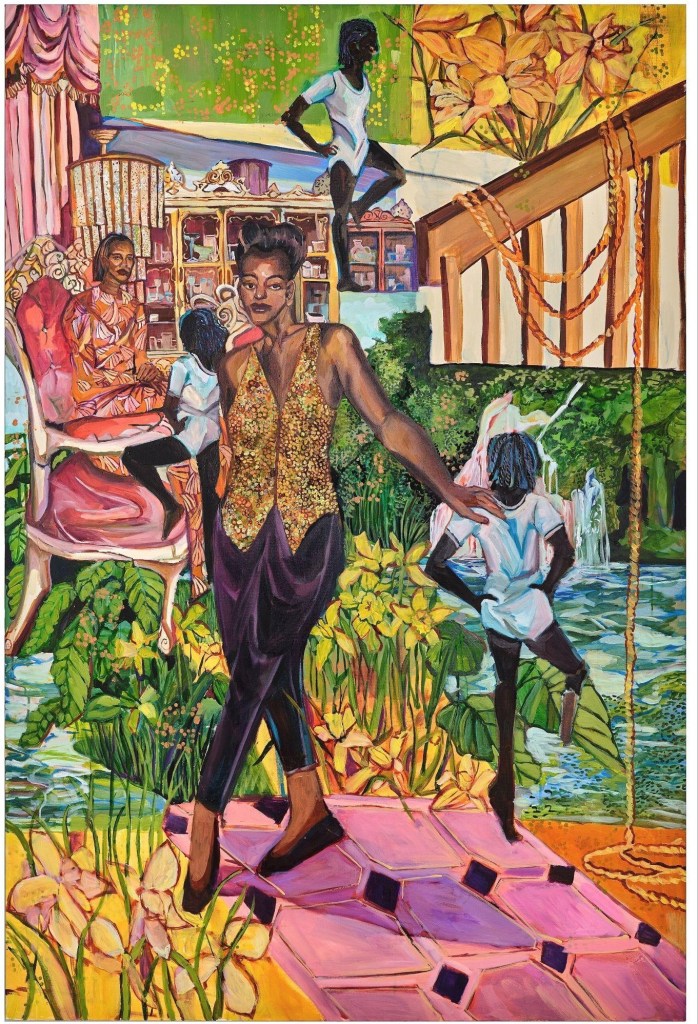
It was up to me to make sure my daughter never slept with ghosts (2021) (see image 1) is a multilayered oil and acrylic painting, measuring 48 by 72 inches (Finéus 2024). At first glance, the viewer is attracted to the painting by its usage of bright colours, pinks, yellows, greens, and oranges. Finéus paints a woman at the forefront with bold lines, highlighting her importance in this hybrid setting of Haiti’s greenery and Canada’s domestic life, its depiction on the canvas giving depth and volume to the painting. In the background, an older woman sits on a chair and the motif of a younger girl wearing a leotard is repeated three times. One might question, who exactly are these women and girls?
Finéus was inspired by her family’s archives, directly pulling images of the figures and painting elements from photographs (Personal Communication 2024). For example, in the back left, the display cabinet and chandelier were from her mother’s time growing up in Montreal, an important area for the Haitian diaspora (Personal Communication 2024). Under the chandelier, sits a woman on a chair who Finéus illustrates as her late aunt (Personal Communication 2024). Upon immigrating to Canada, Finéus’ eldest aunt passed away from an illness and soon following her was her young daughter (Personal Communication 2024). After their deaths, the role of the eldest in the family was passed down to Finéus’ mother who bore the responsibilities of her new role with pride, becoming the “breadwinner” of their home (Personal Communication 2024). Finéus commented how the duties of being the eldest daughter shaped her mother (Personal Communication 2024). In fact, the woman with the crossed legs standing in the front of the painting is Finéus’ mother (Personal Communication 2024). On the opposite, top right side of the painting, Finéus informed me that the stair railings are an exact portrayal of the handrail from her childhood home pushing forward the sense of nostalgia, however, the long rope twisting around the wood is a hint to Haitian literature (Personal Communication 2024).
Célius remarks that postcolonial studies stemmed from literature (Célius 2023, 10) while Ulysse describes how Haitian artists and writers explored the popular rural and urban experiences of Haiti in their postcolonial works, calling the intersection between these worlds as “l’autre du dedans”, highlighting the importance of the quest of understanding one’s identity (Ulysse 2023, 1). For example, Dany Laferrière, a Canadian-Haitian author, in his book The Enigma of the Return studied the memories of his father, to not only connect better with him but with his culture (Ulysse 2023, 2).
Similarly, the impact of literature in Finéus’ works is unavoidable. Memories are a significant theme in this work as Finéus explores the memories of her mother, her late aunt she had not met and her own childhood memories, intermingled with a version of memories found in women-led literature. The rope that was previously mentioned, Finéus relates to Evelyne Trouillot’s book, The Infamous Rosalie, when each time the protagonist aided an enslaved woman with her abortion, she tied a knot with her rope (Personal Communication 2024). From my understanding, it was a method of documentation, of retaining women’s history but also a form of motherhood stemming from a decision to protect their child from slavery. Finéus believes making difficult decisions is something migrant mothers do for their children so they can benefit from the advantage of living in a new country (Personal Communication 2024).
Another element of It was up to me to make sure my daughter never slept with ghosts, that refers to literature, are the daffodils, borrowed from the novel Breath, Eyes, Memory by Edwidge Danticat, telling the story of a mother and daughter living as immigrants in the United States (Personal Communication 2024). In the novel, the daughter is described by Finéus as being “uprooted” from her life in Haiti while adjusting to life in the US, the protagonist writes a poem about daffodils to symbolize her mother’s resilience, since the European flower was brought to Haiti by French colonizers but was able to flourish and adapt to the new country’s environment (Personal Communication 2024). While fondly discussing her mother, Finéus characterizes her as, “A highlife presenting woman, she really loves beautiful things” (Personal Communication 2024). Finéus wanted to encapsulate the idea of beauty and the beauty of migration in her painting (Personal Communication 2024). The artist herself is also included thrice as the floating figures, hinting at a time she was put in ballet lessons by her mother, where for the first time she felt “different” (Personal Communication 2024). Going to these classes derived from a sense of striving to be the “perfect migrant” on the part of Finéus’ mother (Personal Communication 2024) which I understood as an attempt to assimilate, a sentiment shared by many immigrant families, hoping that participating in certain customs or activities will make life easier in a new environment. Thinking about her short-lived ballet days, the artist commented, “My role as…her only daughter trying to persevere through different kinds of spaces growing up, in order to appease the image of living here [Canada] in the different ways, we have to present in different kinds of stages. We have to adhere to be the perfect this or perfect that”(Personal Communication 2024). Additionally, the reason for being represented three times as a young girl is hinting at her grandmother having only three living daughters after the death of Finéus’ aunt and wondering how old her deceased cousin would have been (Personal Communication 2024). All of this showcases how the stories of various Haitian women transcend in Finéus’depiction of her identity.
May this country be hers one day
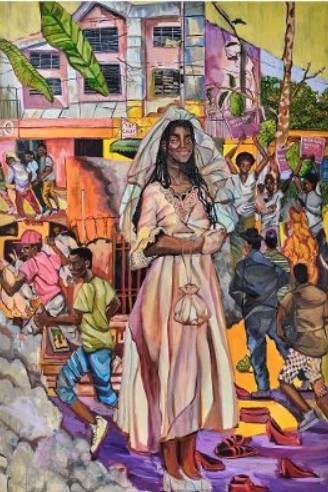
May this country be hers one day (48×72”) (see image 2), was created with oil and acrylic paint in 2020 (Finéus 2024) and will be broken down using Panofsky’s iconography theory. There are three steps to his method of analyzing art, the first being “préiconographique” where the spectator observes the art on a visual and surface-level basis (D’alleva 2006, 1). Following the “préiconographique” step, Finéus’ painting demonstrates a girl wearing a pink dress, gazing at the viewer, standing amidst the chaos of a busy Haitian street. The second step, “iconographique”, asks to relate the art to a historical moment or a known person (D’alleva 2006, 1). Upon further examination, protestors in the back right can be noticed holding signs asking to remember a woman’s name. Knowing that Finéus depicts women’s stories in her works, I was reminded of Iran’s Woman Life Freedom movement. The busy streets, the posters, the innocent-looking woman in the forefront, and possibly due to my own biases, had me making that connection. After this, Panofsky’s third step, “iconologique” demanded assessing the paintings while taking into account the artist’s cultural background, style, environment, and time of production to understand the significance of the painting (D’alleva 2006, 1).
Bearing this in mind, I researched Evelyn Sincère, the name on the poster. Evelyn Sincère was 22 years old, having recently finished her exams at Lycée Jacques Roumain but unfortunately, she did not live to receive her results (Danticat 2020). Evelyn was kidnapped and while her older sister, Enette, negotiated with the kidnappers for her freedom, she was killed (Danticat 2020). The photograph of Evelyn’s dead body, wearing only a bra while on a pile of trash near the side of the road circulated (Danticat 2020). Her killers were aware that they could murder her with “impunity” and not be held accountable, because they did not fear a system that sees women like Sincère as “disposable” (Danticat 2020). Nou Pap Dòmi reported over 120 kidnappings before the end of 2020 (Danticat 2020) showing this issue was a problem across the country.
Finéus portrays the public protests against femicides in Haiti, referring to the photographs of Kay Fanm, a women’s rights group who founded the #StopFeminisid movement (Gené 2021). Finéus also acknowledges the victims of femicides from other countries like Mexico City by including red shoes in her painting, a nod at the demonstration by Mexican activists who also protested against the femicides in their country (Gené 2021).
During our discussion, Finéus clarified that the girl in the forefront is her young cousin, wearing the artist’s soft pink communion dress (Personal Communication 2024). Her cousin was a student living in Haiti during the times of the anti-femicide protests in 2020. Finéus recounts her relatives’ difficult experience of going to school during the rise of femicides and COVID shutdowns (Personal Communication 2024). Her cousin was able to immigrate to Canada that same year and start a new chapter of her life (Personal Communication 2024). Through the process of working on this painting, Finéus was able to learn about her cousin’s life story; from surviving the 2010 earthquake in Haiti, all the way to immigrating to a new country, she has experienced her fair share of violent hardships (Personal Communication 2024).
Laurent Jenny believes the gaze is both one’s perception and an “expérience hasardeuse” (Ruby 2023, 1). Much like the previous painting, the subject of Finéus’ May this country be hers one day and her other works, makes eye contact with the viewer, like the subject knows the spectator is watching her and welcomes their viewership with calm confidence, almost whispering, yes, watch and learn my story.
Imagine our surprise when we found out we had limits
Imagine our surprise when we found out we had limits (48 by 72”) (see image 3) is an acrylic and oil self-portrait painted in 2020 (Finéus 2024), the title inspired by Danticat’s novel Breath, Eyes, Memory (Gené 2021). The painting is almost surrealist, almost like it is a dream. It harbours Célius’s three elements, the lines are predominant, as seen in the drapes and stairs, there is volume as there is a dimension to the perspective, and an abundance of vivid colours (Toussaint 2007). Starting from the top left corner of the canvas, it appears that the sky is a disintegrating sunset, composed of thick rectangle brushstrokes, adding to that surrealist feeling. In the background, the Centre d’Art d’Haïti is illustrated but obstructed by drapes and the foliage of the spurting trees. Two of the women in the back can be distinguished as Finéus’ mother and grandmother (Personal Communication 2024). While the two other women in the background are anonymous artists (Personal Communication 2024), purposefully taking up space on the canvas and in the art world Finéus has created, since women have often been erased from the history of the institutionalization of art in Haiti (double presence/absence). It can be interpreted that these Haitian women, the artists, and her family members, standing behind Finéus represent the path they paved for Finéus to be where she is now. She stands proudly, wearing her stepfather’s suit (Personal Communication 2024). Finéus plays with the concept of double presence and double absence by representing herself in Haiti while having never visited her motherland. The suitcase at her feet is filled with Canadian immigration papers, winking at migration and that aspect of her familial history. In this self-portrait, the artist is channeling “male characteristics” as her posture is similar to the statue made in honor of the Battle of Vertières in Cap-Haitien, and its composition is reminiscent of the men being in the front whereas the women are pushed in the back, while Finéus recounts, “ they’re all fighting the same battle” (Gené 2021). Simultaneously and ironically, Finéus is posing and having her portrait done in her self-portrait. In Imagine our surprise when we found out we had limits,
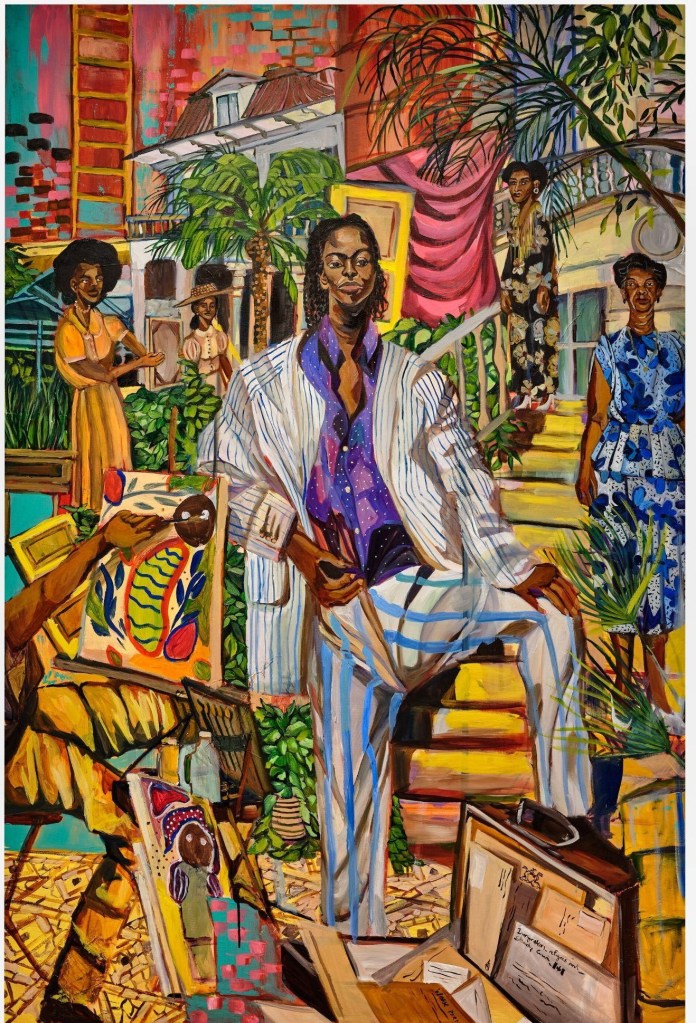
Finéus depicts herself in detail, from the folds of her clothes, the shadows under her throat to the strands of her eyebrow hairs. Clearly, there is nothing spontaneous about her rendition of herself, as it is meticulously thought out; however, the manner in which she is being depicted in the portrait within her self-portrait is the spontaneous style of naive art.André Breton, a surrealist, traveled around the world and visited Haiti (Antle 2015,117). In the 1950s, naive art was popularized to relate to Haitian art because Breton was engrossed by Hector Hyppolite’s works causing a “hypnotic experience”, focusing on the connection between voodoo and surrealism (Toussaint, 262). Hence Breton’s interest in Haitian art was able to reach a more global audience but he imposed the term “naive art” on Haitian art due to its spontaneity and because the artists behind the works had not cultivated their craft by studying at an art school (Dortilus class September 30 2024). By including the rendition of naive art as someone else portraying her in her self-portrait, Finéus criticizes the West’s perceptions about Haiti but also critiques the Haitian patriarchal culture through her masculinization.
Surrealism and Masculinization
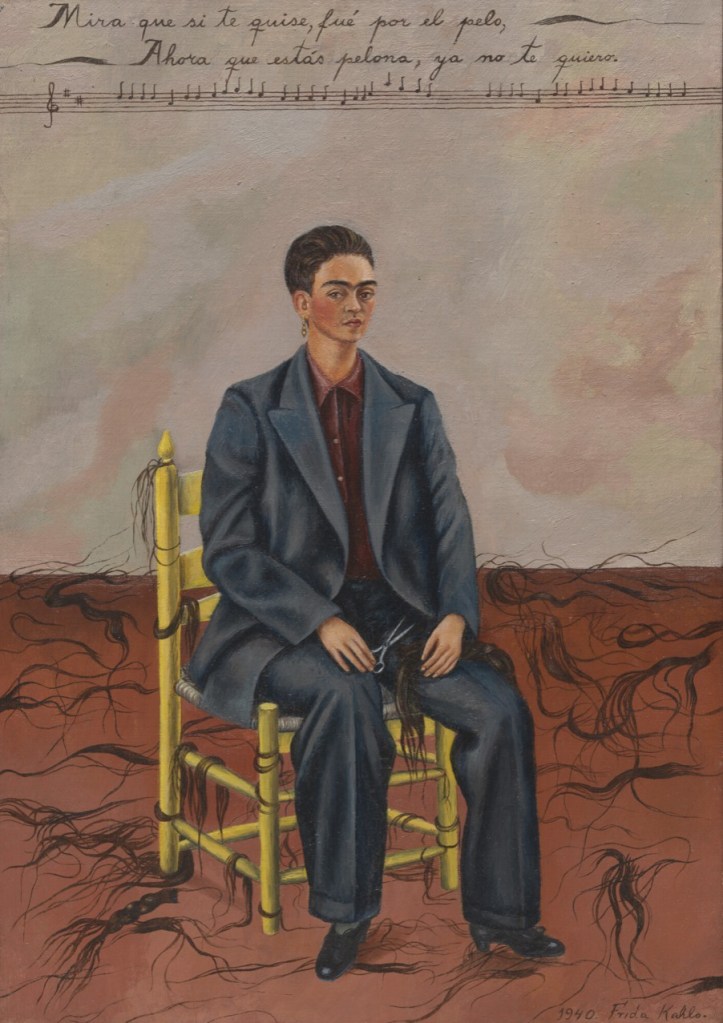
The surrealist movement did not pioneer transnationality in the arts but they were revolutionary in the manner in which they strived to “internationalize” (Antle 2015, 118). They attempted to “embrace” different cultures and “cross-fertilize” to provoke their Western viewers (Antle 2015,118). However, in recent years, they have been rightfully criticized for pushing the notion of “primitivism” (Antle 2015,118) as it has had negative consequences. Imagine our surprise when we found out we had limits balances these notions, evoking the captivating feelings of surrealism by entertaining whether or not this is an exhibition of the artist’s unconscious imagination by amalgamating herself to a country she has not stepped foot in, simultaneously criticizing the label of “naive” forced on Haitian art. While examining Laurena Finéus’ self-portrait, I wondered what surrealist painter is interested in illustrating her identity, culture and exploring her femininity on the canvas. The answer is Frida Kahlo, particularly in her 1940 Self-Portrait with Cropped Hair (see image 3) (Moma 2024). Kahlo paints herself sitting on a yellow wooden chair, wearing a suit after having recently cut off her long locks as she still holds the scissors resting on her lap. Finéus’ self-portrait reminded me of Kahlo’s 1940 Cropped Hair because they share many parallel elements. Both artists masculinize themselves by wearing suits and the way they hold themselves in their postures. Kahlo has short hair, surrounded by the evidence of her haircut while Finéus sports an androgynous hairstyle. Also, both artists illustrate themselves with a unibrow. Although they share similarities they are at the same time vastly different. Finéus’ portrait includes a busy background and significant elements that make up her identity, such as the influential women in her life, demonstrating the transcendence of their stories into her life. Whereas, Kahlo is alone, with a flat beige background with pink splotches, where the lyrics and notes of “Look, if I loved you it was because of your hair. Now that you are without hair, I don’t love you anymore”, which is a Mexican song, is transcribed above her head (Moma 2024). Self-Portrait with Cropped Hair has been described as a “vengeful picture” because it is a reaction to Kahlo’s divorce from Diego Rivera (Cocks 2006, 194). In her self-portrait, Kahlo does not wear the feminine Tehuana dress her ex-husband preferred or her long braided hair that he adored (Cocks 2006, 194). Additionally, it is believed that the oversized suit Kahlo wears originally belonged to her ex-husband, sending a message to him (Cocks 2006, 194) that she does not need him in her life. In a way, Frida Kahlo also participated in her version of déchoukaj by uprooting herself from the appearance she had spent years curating for her ex-husband.
Finally, one last difference between the two self-portraits of these women tackling the discovery of their identities, is that Kahlo signed her painting while Finéus did not. It is quite a mystery why Laurena Finéus has opted to not sign her name on all of her paintings from the Déchoukaj’ exhibition works. Signatures are utilized to leave a mark (Agamben 2008, 38). However, Nancy explains how the concept of “ekphrasis” permits the artist’s name to identify their body of work, for instance saying ‘This is Da Vinci!’ (Nancy 2015, 33). I believe viewers can easily identify Finéus’ work from her distinct style of mixing different parts of her identity to create her aesthetic. I can imagine people in a classroom raising their hands to say, « This painting is obviously a Finéus because…”
One can argue that signatures are a Western practice. Is the lack of signature a deliberate choice, a hidden act of defiance with anti-colonial sentiment? Is the representation of Finéus’ diasporic identity and unique art style enough to distinguish her art? Perhaps, Finéus does not need to sign her work because the paintings from the Déchoukaj’ exhibition themselves are the “signature”, leaving her mark.
Conclusive Reflection
Laurena Finéus’ paintings deserve to be analyzed because they exhibit themes that resonate with a broad demographic while representing a niche identity, her identity transcended from the women in her life and those who came before her. Her paintings are a vessel that allows recounting her stories and those of other Haitian women, like her grandmother, mother, aunt, cousins, and even women’s stories from literature. In It was up to me to make sure my daughter never slept with ghosts, Finéus illustrates immigration and the sacrifices of motherhood. With May this country be hers one day she portrays the reactive aftermath of femicide. Lastly in her self-portrait, Imagine our surprise when we found out we had limits, she pokes at the West’s views on Haitian art while critiquing its patriarchy within the art world. The self-portrait was then intersected with an analysis of Kahlo’s surrealist painting. As showcased in the research, nostalgia and double presence/absence are key factors in Finéus’ art works. Laurena Finéus represents the experiences of Haitian women in her paintings, featured in the Déchoukaj’ exhibition, illustrating and uplifting their stifled stories, captured from the lens of her diasporic perspective.Her works contribute to the history of art with a taste of originality by creating a special aesthetic involving her experience as Haitian and Canadian. The study of art history and its roots are very European, built on colonial ideals. To help with its uprooting, it is crucial, to study artists’ bodies of work like Finéus that deal with post-colonial themes and whose identity has plurality. Finéus’ paintings provide a representation of not only Haitians in the diaspora but also capture a diasporic feeling, intriguing and reaching out to people from other diasporic communities.
All of this makes one wonder, how will the portrayal of Haitian women and their stories be represented in art by future generations, as the children of the diaspora will have more distance from their ancestral roots since their parents also grew up outside of Haiti. How will the next generation of Haitian artists in the diaspora represent a Haiti they understand only from an ancestor’s story? All in all, we must remember how women’s history has been shared throughout the passage of time. A mother has always been a daughter first, carrying the stories of her mother, until one day she can pass along those memories to her own daughter, continuing the cycle.
Dana Mehdipour-Haidari
Bibliography
A) Articles
“About.” Laurena Finéus. Accessed December 15, 2024. https://laurenafineus.com/about-1. Agamben, Giorgio (2008), Signatura rerum. Sur la méthode. « Chapitre second », pp. xxxx. Paris
: seuil.
Antle, Martine. “Dada and Surrealism Faced with Colonialism.” South Central Review 32, no. 1 (2015): 116–19. http://www.jstor.org/stable/44016881.
Célius, A. Carlo. (2023). Création plastique d’Haïti – Art et culture visuelle en colonie et postcolonie, Éditions Maison des sciences de l’homme Collection Amérique(s).
Cocks, Neil. “On Frida Kahloʹs Moustache: A Reading of Self-Portrait with Cropped Hair and Its Criticism.” In The Last Taboo: Women and Body Hair, edited by Karín Lesnik-Oberstein, 191–208. Manchester University Press, 2006. http://www.jstor.org/stable/j.ctt155j918.16.
Danticat , Edwidge. “Evelyne Sincère Is Haiti; She Is Also All of Us.” Woy Magazine, March 12, 2021. https://woymagazine.com/2020/11/06/evelyne-sincere-is-haiti-she-is-also-all-of-us/.
“Frida Kahlo. Self-Portrait with Cropped Hair. 1940: Moma.” The Museum of Modern Art. Accessed October 12, 2024. https://www.moma.org/collection/works/78333#top.
Gené, Dominique. “Uprooting the Patriarchy: Laurena Finéus’ ‘Déchoukaj’ Affirms Haitian Womanhood.” Arts Help, November 15, 2021.
https://www.artshelp.com/uprooting-the-patriarchy-laurena-fineus/.
Jean-Pierre, Jean-Ederson. “Dézafi / Les Affres d’un Défi et Le Paradigme Dechoukaj.” Journal of Haitian Studies 27, no. 2 (2021): 135–54. https://www.jstor.org/stable/27155422.
Katsman, Anastasia. “Déchoukaj , 2021.” Laurena finéus. Accessed December 16, 2024. https://laurenafineus.com/dechoukaj2021.
Langage plastique et énonciation identitaire. L’inventeur de l’art haïtien. Par Carlo A. Célius. (Québec Presse de l’Université Laval, collection Intercultures, 2007. Pp. 432, ISBN
978-2-7637-8637-7)
L’expérience du regard dans la fabrication de l’œuvre d’art : recherche et collecte en création artistique ruby, C. Arts visuels : De
l’importance du regard en art, publié le 24 février 2023
https://www.nonfiction.fr/article-11635-de-limportance-du-regard-en-art.htm
Nancy, J.-L. (2015). Ekphrasis. Études françaises, 51(2), 25–35. https://doi.org/10.7202/1031226ar
Panofsky, Erwin, Cité par Anne D’alleva, in Méthodes et théories de l’Histoire de l’art, Éditions THALIA, Paris, France, 2006.
Souriau, Étienne, La correspondance des arts, Flammrion, Paris, 1969, p.1279-1321 (récapitulation).
Sterlin Ulysse (2023). Les figures de l’autre dans la littérature et la peinture haïtiennes, Gouttes Lettres.F
B) Visual Documents
Finéus. L (2020). Imagine our surprise when we found out we had limits. [Acrylic and oil on canvas].
Finéus. L (2021). It was up to me to make sure my daughter never slept with ghosts. [Acrylic and oil on canvas].
Finéus. L (2020). May this country be hers one day. [Acrylic and oil on canvas]. Kahlo.F (1940). Self-Portrait with Cropped Hair. [Oil painting].


Discussion
Pas encore de commentaire.